Meeting Check-Ins: The First Five Minutes of Your Meeting Are Doing More Than You Think
People collect all kinds of interesting things.
I collect meeting check-ins. 😊
Whenever I come across one I really like, I tuck it away for later. Some I've borrowed and adapted. Some I've created myself because nothing else quite fit the group in front of me.
One day I got curious enough to count them.
Sixty-eight. And I'm pretty sure I'm not done collecting.
There's a reason I've held onto them. After more than 20 years of facilitating meetings and retreats, I've learned that the way you begin can shape what happens next.
People rarely walk into a meeting as a blank slate. They may be finishing an email in their head, coming straight from another meeting, distracted by something happening at home, or wondering why this meeting couldn't have been an email. 🙃
A thoughtful check-in gives people a chance to arrive.
But the key word there is thoughtful.
The best opening activity isn't necessarily the funniest one, the most creative one, or the one that worked beautifully with another team last week.
It's the one that fits what this group needs today.
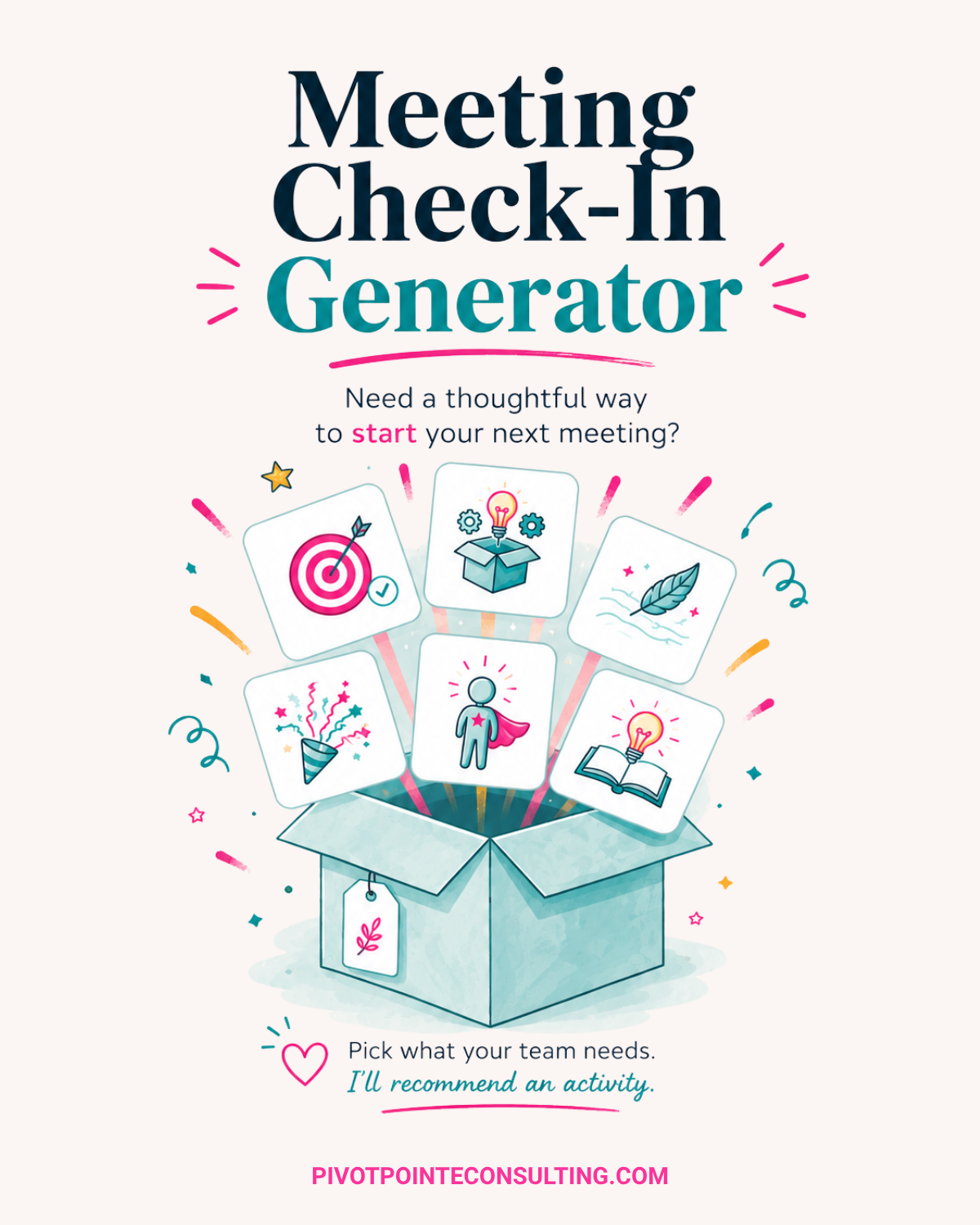
What Does Your Team Need Today?
When I'm planning a meeting or retreat, I don't start by asking, "What's a good icebreaker?"
I'm thinking about the people who will be in the room.
What are we asking them to do together? What's happening for this group right now? What kind of energy would help them move into the work ahead?
A team might need:
Connection after time apart or when relationships need a little attention
A chance to settle in before moving into a full agenda
Reflection before a decision or meaningful conversation
Celebration after reaching a milestone or making progress
Energy and fun when the room needs a lift
Intention setting to help people focus on how they want to participate
Fresh thinking before brainstorming, problem-solving, or planning
There's no universally perfect meeting check-in because there is no universally identical meeting room.
That's part of facilitation: paying attention to the people, the purpose, and the moment.
The Right Check-In for the Right Room
Most of us have probably experienced an opening activity that felt a little awkward, forced, or disconnected from everything that came after it.
The problem usually isn't the idea of a check-in itself. It's that the activity wasn't chosen with much intention.
Share a Tiny Delight might be just right for a group that could use a little lightness. A reflective question may create a useful transition into an important conversation but feel unnecessarily heavy before a meeting that simply needs some energy.
That's why I think of a check-in as a facilitation tool, not something to add because the agenda says "Icebreaker: 10 minutes."
You're choosing it for a reason.
How My Collection Became a Generator
A while back, I shared some of my favorite check-ins during a facilitation training and sent participants home with a list of activities.
People loved the list, but afterward I started thinking about what would make it even more useful.
Because a list still leaves you with the most important question:
Which one should I use?
I wanted to create something that could help answer that question, not by randomly selecting an activity, but by starting with what your team needs.
That idea eventually became the Meeting Check-In Generator.
How It Works
The free generator starts with one simple question:
What would be most helpful for your team today?
Choose from Connection, Settle In, Reflection, Celebration, Energy & Fun, Intention Setting, or Fresh Thinking, and the generator recommends an activity that fits.
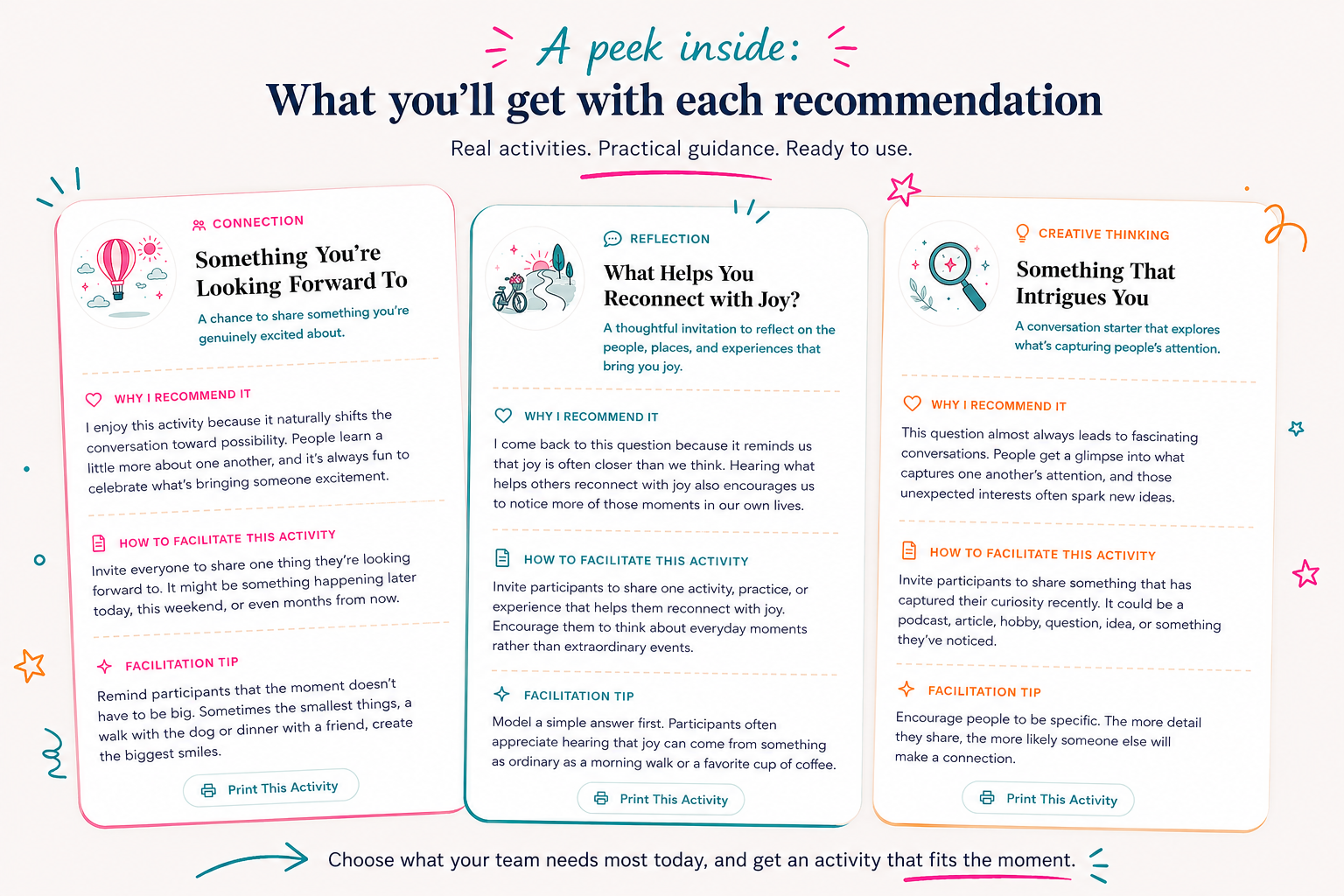
I also wanted each recommendation to include more than the activity itself. It includes some of the same thinking I'd use when preparing to facilitate it myself.
The activity: Quickly see what you're inviting the group to do
Why I recommend it: Understand the thinking and intention behind the activity
How to facilitate it: Know how to introduce and guide it with your group
A facilitation tip: Get a little extra guidance to help the activity land well
Many of the activities take only a few minutes and are designed to fit comfortably into a meeting rather than taking over the agenda.
A Few Things I've Learned About Making Check-Ins Work
Finding a good activity is only part of it. How you introduce and facilitate the check-in makes a difference too.
Here are a few things I've learned along the way:
1. Model the level of sharing you're inviting.
In most cases, the leader or facilitator should go first. It gives people an example of what you're asking for and helps establish the appropriate depth.
If you want a 30-second answer and give a five-minute monologue, well...you've just taught everyone something too. 😆
2. Make passing an option.
Especially with reflective or more personal questions, let people know it's perfectly fine to pass.
An invitation feels very different from an obligation.
3. Match the level of vulnerability to the group.
Consider how well people know one another and the level of trust already established. A newly formed group doesn't need to start by sharing something deeply personal to create connection.
4. Give people a moment to think.
Ask the question and allow a few seconds before calling on someone.
Introverts everywhere will thank you. 🙋🏾♀️
5. Watch the time without rushing people.
If you have 15 people and a five-minute opening, choose something that can genuinely work in that amount of time.
6. Don't turn every answer into a discussion.
If someone says something interesting, it can be tempting to respond, ask follow-up questions, or start problem-solving.
Sometimes the best facilitation move is simply to thank them and let the check-in continue.
The goal isn't to follow a perfect formula. It's to be intentional about what you're inviting people into and thoughtful about how you guide them through it.
Ready to Try One?
Before your next meeting, take a minute to ask yourself:
What would be most helpful for this team today?
Then head over to the Meeting Check-In Generator, choose your answer, and I'll recommend an activity for you.
Find a check-in for your next meeting.
And if you have a favorite meeting check-in that isn't in my collection yet, send it my way.
Apparently, 68 isn't enough. 😊
Planning Something Bigger Than a Weekly Meeting?
Sometimes you need more than a great opening question.
If you're planning a team retreat, board retreat, planning session, or another gathering where people need time to reconnect, make decisions, think together, or work through something important, thoughtful facilitation can make a tremendous difference.
It's hard to participate fully when you're also trying to manage the agenda, watch the clock, read the room, and figure out what needs to happen next.
That's where I come in.
Learn more about facilitation with Pivot Pointe.
Meeting Check-In FAQs
What is a good meeting check-in question?
A good meeting check-in question fits what the group needs in that particular moment. A team heading into a difficult conversation may benefit from reflection, while a group that hasn't seen one another in weeks might need connection.
Rather than starting with "What's a clever question?" try asking, "What would be most helpful for this group today?"
Why is a meeting check-in important?
A meeting check-in helps people transition from whatever they were doing before the meeting into the conversation they're about to have. It can help a group reconnect, settle in, shift their energy, or prepare for the work ahead.
It doesn't have to take a lot of time. Even a few intentional minutes at the beginning can change how people enter the rest of the meeting.
How long should a meeting check-in take?
Many effective check-ins take only a few minutes. Others need a little more time, particularly with larger groups.
Choose an activity that realistically fits the time you have rather than rushing people through it.
Who should lead a meeting check-in?
Anyone on the team can lead a meeting check-in. In fact, rotating who leads can be a nice way to involve different team members.
Whoever facilitates the activity should usually go first. That gives everyone an example of what you're asking for and helps model the level and length of sharing you're inviting.
Can I use meeting check-ins in virtual meetings?
Absolutely. Many check-ins work just as well on Zoom as they do around a conference table, and others can be adapted with a small adjustment.
The same principle applies either way: choose an activity that fits the people and what you're asking them to do together.

Hi, I’m Monique!
Monique Stevens is a leadership coach, facilitator, Organization Development consultant, and founder of Pivot Pointe Consulting. She partners with organizations to help leaders and teams navigate change, strengthen relationships, and work together more effectively.
Learn more about Monique →